

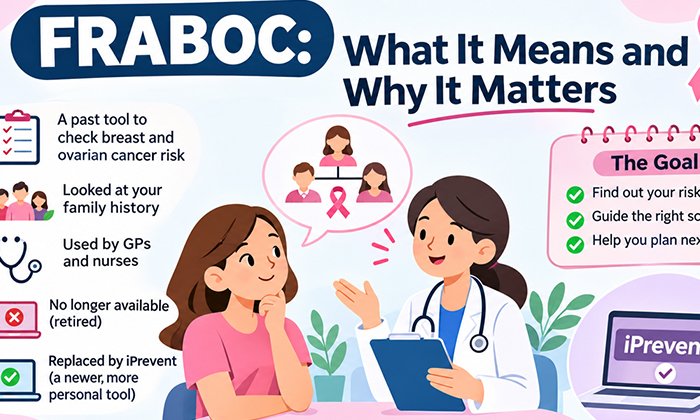
Seeing the word FRABOC in an old health letter can be confusing. You may wonder if it is a test or a type of cancer. The good news is that its meaning is much simpler than it may sound.
FRABOC was an Australian health tool. It helped doctors and nurses look at a woman’s family history of breast and ovarian cancer. It helped them see if her family history showed signs of a higher cancer risk.
Today, FRABOC is no longer active. Still, the idea behind it remains important. In this guide, we will explain what FRABOC means, how it worked, who used it, and why family cancer history can matter.
What Is FRABOC?
FRABOC was a tool used to check family cancer risk. It was made for health workers in Australia. A doctor or nurse could use it while talking with a woman about breast or ovarian cancer in her family.
The tool looked for patterns. For example, it could consider whether a mother, sister, aunt, or grandmother had cancer. It also looked at other relatives and which side of the family they came from.
FRABOC did not tell someone that she had cancer. It only helped show whether her family history might place her at a higher risk. This could help the doctor decide what steps might be useful next.
What Does FRABOC Stand For?
FRABOC is also written as FRA-BOC. It stands for Familial Risk Assessment – Breast and Ovarian Cancer. The long name may sound hard, but the basic idea is easy to understand.
“Familial” means connected to a family. “Risk assessment” means looking at facts to understand possible risk. The last part tells us that FRABOC focused on breast cancer and ovarian cancer.
Think of it as a way to organize a family story. Instead of simply saying, “Cancer runs in my family,” a doctor could look at who had cancer, what kind they had, and when they were diagnosed.
Why Was FRABOC Created?
Family cancer history can be difficult to understand. One person may have a mother with breast cancer. Another may have several relatives who had breast or ovarian cancer at young ages. These situations do not always carry the same risk.
FRABOC gave doctors a more organized way to look at these details. It helped them move beyond a simple yes or no question about cancer in the family. The wider pattern could then be considered.
This was useful because family history can sometimes point to an inherited cancer risk. However, having cancer in the family does not always mean there is an inherited gene change. FRABOC helped doctors decide when more attention may be needed.
How Did FRABOC Work?
A GP or nurse would normally use FRABOC during a health visit. The patient did not need to sit at home and work everything out alone. The health worker would ask questions about cancer in the family.
The questions could cover which relatives had breast or ovarian cancer. The age when cancer was found was also important. A diagnosis at a younger age may sometimes be more important when doctors look for inherited patterns.
FRABOC then helped place the family history into a risk group. That result could guide the next talk. Some women might need normal screening. Others might need more checks or a referral for specialist advice.
Who Used the FRABOC Tool?
FRABOC was mainly designed for healthcare workers. General practitioners and practice nurses were among the people who could use it. It was not made as a simple online quiz for people to diagnose themselves.
This point is important. Someone could not use FRABOC to find out if she had breast cancer. A doctor also could not use it as proof that cancer would develop later. It was only one part of risk assessment.
The real value of FRABOC was the conversation it supported. It gave a doctor a clear way to ask useful questions. It also helped patients understand why some family cancer cases mattered more than others.
FRABOC Risk Categories Explained
FRABOC used broad risk groups to help doctors understand family history. One group covered women with an average or slightly higher risk. This was where many women could fall based on their family history.
Another group covered a moderately increased risk. This could apply when the family history showed a stronger pattern. A doctor could then look more closely at the woman’s needs and discuss whether different screening advice was suitable.
The highest group covered a potentially high risk. This could include strong family cancer patterns or known inherited gene changes. In these cases, specialist advice or a Family Cancer Clinic could be considered. The category itself was never a cancer diagnosis.
FRABOC and Your Family Cancer History
Family history was a big part of FRABOC. The tool looked for cancer patterns in a family. One relative with breast cancer did not always mean a woman had a high inherited risk.
Doctors looked at the full family story. Several relatives with breast or ovarian cancer could be important. The age when cancer was found also mattered. Cancer found at a younger age could sometimes need a closer look.
Other patterns could also stand out. These included male breast cancer or both breast and ovarian cancer in one family. A known BRCA1 or BRCA2 gene change could also be important when looking at inherited risk.
Does Your Father’s Family History Matter?
Yes, your father’s family history matters too. This is an important point that people can easily miss. When thinking about breast and ovarian cancer risk, doctors may look at relatives on both sides of the family.
A gene change linked with cancer risk can come from either parent. This means cancer in your father’s family should not be ignored. His mother, sisters, aunts, and other close relatives may provide useful family history.
Before seeing your GP, try to collect information from both sides. Write down who had cancer and what type they had. If possible, also note their age when they were diagnosed. These details can make the talk much easier.
Up Next: Daniel Clifton Pratt: Everything to Know About Chris Pratt’s Dad
Is FRABOC a Cancer or Genetic Test?
FRABOC was not a cancer test. It could not tell a woman that she had breast or ovarian cancer. It also could not promise that she would or would not get cancer later in life.
It was not a genetic test either. Genetic testing looks for certain changes in genes. FRABOC instead used family information to help a health worker understand whether further assessment might be useful.
This difference is very important. Having a higher risk is not the same as having cancer. If someone has symptoms or an unusual screening result, they need proper medical care. A family risk tool cannot replace those checks.
Why Is FRABOC No Longer Available?
In 2026, the old FRABOC tool is no longer available through Cancer Australia. This can be confusing if you see the name in an old health record, referral letter, or clinic document.
Health tools change as new research becomes available. Doctors now have newer ways to look at breast cancer risk. These methods can use more information and may give a more personal picture than older family-history tools.
The end of FRABOC does not mean family history stopped being important. Doctors still ask many of the same key questions. Who had cancer? What type was it? How old were they? Which side of the family were they on?
FRABOC vs iPrevent: What Changed?
One modern tool worth knowing about is iPrevent. It was developed through the Peter MacCallum Cancer Centre. It is designed to help women and health workers understand breast cancer risk and discuss ways to manage that risk.
FRABOC mainly focused on family history. Modern breast cancer risk tools can consider more details. These may include age, family history, breast density, past breast problems, hormone use, and other personal health factors.
iPrevent can provide a more personal breast cancer risk estimate instead of only placing someone into a broad group. It can also help guide talks about screening and ways to lower risk. Results should still be discussed with a health professional.
Up Next: Tom Cates: Everything to Know About Kelly Cates’ Former Husband
What to Do If You Find FRABOC in Your Records
Imagine opening an old referral letter and seeing “FRABOC” written on it. The word may look worrying. However, seeing it does not mean that a doctor found cancer or a harmful gene change.
It may simply mean that your family cancer history was reviewed at that time. If you are unsure what the old note means, take it to your GP. Ask whether your family history should be checked again using current guidance.
It also helps to prepare before your visit. Write down relatives who had breast or ovarian cancer. Add their age at diagnosis if you know it. Bring any family genetic test reports you have. Clear information can help your doctor understand the picture.
Conclusion
FRABOC may be an old tool, but the question behind it still matters. Family history can help doctors understand whether someone may need normal screening, closer checks, or more detailed advice from a specialist.
The key thing to remember is simple. FRABOC was a risk assessment tool. It was not a cancer diagnosis. It was not a genetic test. It helped health workers make sense of family history in a clear way.
If breast or ovarian cancer appears in your family, you do not need to guess what it means. Gather what you know and speak with your GP. Current tools and medical advice can give you a clearer view of your risk in 2026.
(FAQs)
Is FRABOC still available in 2026?
No. FRABOC is no longer active through Cancer Australia. Newer breast cancer risk tools such as iPrevent are now available.
Did a high FRABOC result mean you had cancer?
No. This is important. FRABOC did not diagnose cancer. It only helped doctors understand possible risk based on family history.
Can breast cancer risk come from your father’s family?
Yes. This surprises many people. Gene changes linked with cancer risk can come from either parent. Your father’s family history can matter too.
Does one relative with breast cancer mean you are high risk?
Not always. Doctors look at the whole family pattern. The number of relatives and their ages at diagnosis can be important.
Was FRABOC a BRCA genetic test?
No. FRABOC was not a genetic test. It reviewed family cancer history. A separate genetic test is needed to look for gene changes such as BRCA1 or BRCA2.
Up Next: What Is PressVibePulse com? A Simple Guide for New Readers
